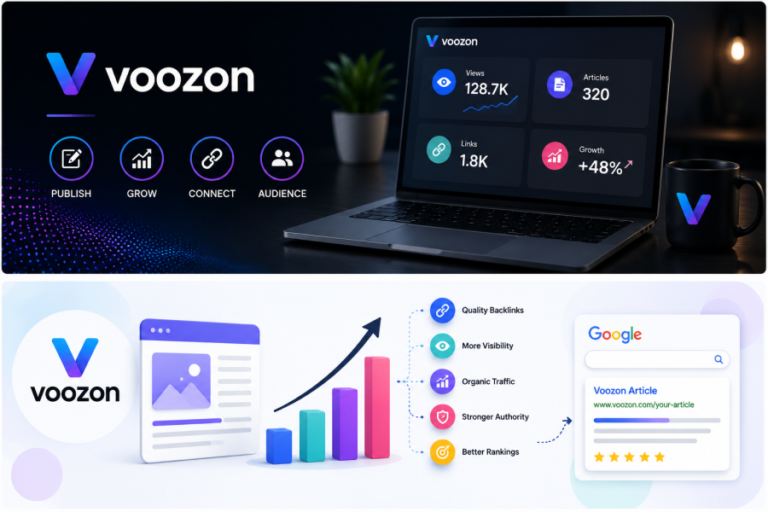
You’ve probably run into the name Voozon somewhere if you’ve been poking around content platforms lately. It kept popping up more through 2026, and the info out there about it is kind of a mess, honestly. Search five sites and you’ll get five different answers. Guest posting tool. Digital publishing site. Marketing platform. Take your pick, apparently.
Part of the problem is that Voozon just doesn’t sit in one box. It borrows a little from a few categories at once, which is probably why nobody can agree on a single label for it. Calling it a multi-purpose publishing platform gets closer to the truth – something that can play different roles depending on what you actually need it for. Content marketing one week, brand building the next, maybe a guest post here and there.
This is meant to cut through some of that. What it does, how it works, where it might actually help your SEO, where it won’t, who should bother with it at all.
Voozon at a Glance
Voozon is, at its core, a multi-niche publishing platform. Businesses and bloggers put articles out across a bunch of topics instead of being stuck writing about one thing forever. Depending on what’s on offer, there’s also room for guest posting, a bit of brand exposure, occasionally a backlink.
Categories run wide – tech, business, marketing, finance, health, education, lifestyle, travel, entertainment, general digital culture. That spread is kind of the whole point. Different writers, different readers, same platform. The underlying goal is simple enough: get decent writing in front of more people than it would reach sitting alone on some personal blog nobody visits.
What Is Voozon Really?
Most of the online confusion isn’t even real contradiction. Voozon just does several things at once, and which one matters depends entirely on who’s using it and why. Multi-niche blog. Guest posting outlet. Digital publishing hub. Content marketing channel. Brand tool. Pick whichever fits your situation.
It doesn’t replace your own website, though not even close, and it’s not trying to. Picture it as an extra lane next to your main road rather than a detour around it. A business might pick up a bit more exposure. A blogger gets another spot for their expertise. A marketer slots it into whatever’s already running. A startup gets a cheap shot at explaining itself to people who’ve never heard of it.
Why Everyone’s Suddenly Talking About Voozon
There’s a fairly simple reason interest picked up. Marketing keeps drifting away from straight ads toward stuff that’s actually useful to read. People are worn out from being sold to constantly and they respond better to content that teaches them something real.
Ads get scrolled past without a second thought these days. Guides, honest explainers, and tutorials still get read. Still get shared, even. Voozon leans into that kind of writing, so it’s lined up naturally with wherever things are heading anyway.
A single website isn’t enough anymore either. Companies publishing only on their own domain are boxing themselves in more than they realize. Spread things across a few trusted channels and the net gets wider. Voozon is one more place to cast that line.
Brand trust also matters more than a hard sell now. Fewer companies chase the quick sale; more try to become names people actually recognize. That takes longer than running ads but tends to stick a lot better once it happens.
It welcomes just about anyone, too, since it’s not locked to one niche. Bloggers, agencies, freelancers, SaaS teams, e-commerce brands – whoever’s got something worth saying and the patience to say it properly.
And there’s a loose SEO angle in there somewhere. No platform can honestly promise better rankings — anyone claiming otherwise is stretching things – but publishing solid work on a reputable outside site can still play a small supporting role.
How Voozon Actually Works
The exact steps shift depending on whatever policy is current, but it broadly follows a pattern you’ve probably seen on other publishing sites before.
| Step | What Happens |
| Sign up | Create an account if it’s required |
| Pick a category | Match your piece to the closest niche |
| Write something worth reading | Original, useful, actually researched |
| Submit it | Send it through editorial review |
| Get published | Once approved, it goes live |
| Spread the word | Push it through social and email |
| Check the numbers | See what traffic and engagement came in |
Nothing revolutionary here, to be fair. Roughly the same workflow as most guest publishing sites. The value isn’t some secret process – it’s just having one more outlet.
What Is Voozon Actually Good At?
Covers a lot of ground, for starters. Not tied to one topic, so it suits organizations working across several markets instead of forcing a single lane.
There’s barely a learning curve. Simple enough interface that you spend time actually writing instead of fighting a dashboard.
It’s one more distribution channel you didn’t have. Sounds obvious, sure, but more outlets really does mean more chances someone stumbles onto your work by accident.
Publish decent stuff regularly and the brand starts showing up more in search results, in shares, in conversations you’re not even part of.
Tends to encourage real engagement too. People respond to writing that solves something or offers a fresh angle. Filler gets scrolled right past.
Structurally it’s reasonably search-friendly. Clear headings, tight paragraphs, keywords that show up where they naturally belong rather than crammed in. Helps readers and search engines both make sense of a piece. Useful first, optimized second that’s really the emphasis
Top Use Cases of Voozon
One of Voozon’s biggest strengths is its flexibility. Unlike niche-specific publishing platforms, Voozon supports content across multiple industries, making it useful for individuals, businesses, and organizations with different goals. Whether you want to educate your audience, increase brand awareness, or support your content marketing strategy, Voozon can serve a variety of purposes.
Voozon for Bloggers and Content Creators
Bloggers can use Voozon to publish original articles and reach readers beyond their personal websites. Sharing valuable insights on a trusted publishing platform helps build credibility, attract a wider audience, and strengthen long-term authority within a specific niche.
Voozon for Small Businesses
Small businesses can publish educational content, product guides, and industry updates to introduce their services to potential customers. This approach increases brand visibility while building trust through informative and helpful content rather than direct advertising.
Voozon for Digital Marketing Agencies
Marketing agencies can include Voozon in their content distribution strategy to expand the reach of client campaigns. Publishing well-written articles on multiple platforms supports brand awareness and complements broader SEO and digital marketing efforts.
Voozon for Startups
Startups often need affordable ways to introduce their products and services. Voozon provides an opportunity to explain business ideas, share company updates, and educate potential customers through informative articles that build credibility over time.
Voozon for Freelancers and Consultants
Freelancers, consultants, and industry experts can use Voozon to showcase their knowledge by publishing practical guides and expert insights. This helps strengthen personal branding and can generate new business opportunities by demonstrating expertise.
Voozon for E-commerce Businesses
Online stores can publish buying guides, product comparisons, and educational content that helps customers make informed purchasing decisions. Useful content also supports customer engagement and improves overall brand recognition.
Voozon for SEO Professionals
SEO specialists can use Voozon as part of a comprehensive content marketing strategy. Rather than focusing only on backlinks, they can publish high-quality, reader-focused content that improves visibility, generates referral traffic, and supports long-term search engine optimization goals.
No matter your industry, the key to success on Voozon is creating original, helpful, and trustworthy content. The platform works best when it is used as part of a broader digital marketing strategy instead of relying on it as the only source of online visibility..
The Real Benefits of Voozon
Knowing what it does is one thing. Whether it helps you comes down to how it’s used.
More eyes on your work, basically. Relying on one website for all your traffic is risky. Spread things across a few reputable platforms and readers get more paths to find you – adds up over time even without anything dramatic happening overnight.
Fits into an actual strategy, too. Good content marketing right now means answering questions people are already asking, not filling a calendar. Guides, tutorials, product explainers, industry commentary — that kind of writing earns attention instead of demanding it.
Reaches different audiences at once. Spans multiple industries, so a company serving several customer types can tailor content to each without running five separate blogs.
Helps build credibility, slowly. People trust brands sharing useful, accurate information over ones constantly pushing product. That trust doesn’t happen overnight – comes from steady publishing and being upfront – but it lines up with what Google looks for under E-E-A-T: experience, expertise, authority, trust.
There’s a modest SEO boost. That’s about it, though. This is where people’s hopes get inflated too far. Voozon alone won’t move rankings. What it can realistically do is add a mention here, a bit of referral traffic there, maybe an occasional backlink. Real SEO value still comes from what’s actually written, not which platform hosts it.
Can Voozon Actually Help Your SEO?
Yes – with conditions. Search engines still reward original, genuinely useful writing, and that hasn’t changed no matter how many algorithm updates roll through. Publish real, thought-through articles instead of disguised ads and it can support wider content efforts.
Don’t lean on one platform too hard, though. A solid SEO approach still needs a strong presence on your own site, decent backlinks, the technical basics handled, a site that loads fast, sensible internal linking, writing aimed at people rather than algorithms, and content that actually gets revisited instead of left to rot.
Supporting player. Not a shortcut to page one. It just isn’t that, no matter how it gets marketed.
Guest Posting: Still Worth Doing, If You Do It Right
Guest posting hasn’t lost value, it’s just gotten far less forgiving of lazy execution. Write for the reader first and whatever SEO benefit shows up tends to follow on its own rather than being the whole point.
A post that actually works solves something real, offers an angle that isn’t recycled, sticks to information you can check, skips the keyword stuffing, and leads with value before anything resembling a pitch shows up.
Do it well, trust builds. Do it carelessly, and it quietly damages both reputation and SEO at once.
Backlinks: Fewer, Better Ones Beat a Pile of Weak Ones
People get drawn to platforms like this chasing backlinks specifically, but that mindset’s a bit dated by now. Google cares far more about link quality these days than how many are sitting on a page.
Strong backlinks come from relevant, trusted sites with real content and placement that feels natural — nothing forced. Weak ones come from spammy pages, thin content, sites with zero real connection to your topic, anything smelling automated from a mile off. Write something genuinely good first. The link value tends to follow from that on its own.
Is It Safe to Use?
From what’s publicly available, it looks and works like a fairly standard publishing platform. Still worth doing your own homework before putting real time or money in, though. Clear contact details. Published editorial guidelines. An actual privacy policy. Some transparency around payment if that applies. Basic due diligence – applies to any platform really, not just this one.
Who Gets the Most Out of It
Bloggers pick up another spot to share what they know and reach readers they wouldn’t otherwise find. Small businesses get a way to educate potential customers while raising visibility at the same time. Agencies fold it into a bigger campaign as one more channel. SEO professionals treat it as a piece of a wider promotion strategy rather than a backlink source on its own. Startups get a cheap way to explain themselves to people who’ve never heard of them. Freelancers get somewhere to demonstrate expertise and build a bit of a personal brand.
Who Probably Shouldn’t Bother
Expecting instant rankings? Guaranteed backlinks? Planning to dump unedited AI content and walk away? This won’t go well. Same for anyone focused purely on self-promotion, skipping editorial standards, or leaning on spammy tactics. None of that works better here than anywhere else on the internet – it never really does.
A Few Things Worth Doing Right
Write original content – avoids duplicate-content headaches, builds trust faster than anything else. Focus on the reader over the algorithm; useful articles hold up longer. Use keywords where they belong instead of forcing them in somewhere. Write headlines people actually want to click, skip the jargon-stuffed ones. Add images where they genuinely help, not just to fill space. Go back and update old posts instead of letting them rot. And actually promote what gets published – it rarely spreads on its own.
Weighing the Pros and Cons
On the plus side: covers a lot of categories, easy enough to use even without prior publishing experience, genuinely supports brand visibility, fits into a broader strategy without much friction.
On the downside: platform features and policies can shift without much warning, SEO results are never guaranteed no matter what anyone promises, and none of it matters if the writing itself is weak. Also not a substitute for owning your own site. Complements one. Doesn’t replace it.
How It Stacks Up Against Other Platforms
| Platform | Best For | SEO Potential | Ease of Use | Multi-Niche? |
| Voozon | Publishing, brand visibility, guest posts | Moderate – depends on content | Easy | Yes |
| Medium | Personal blogging, thought leadership | Moderate | Very easy | Yes |
| LinkedIn Articles | B2B and professional content | Moderate | Easy | Business-focused |
| WordPress | Full site ownership | High, with proper setup | Moderate | Yes |
| Substack | Newsletter publishing | Moderate | Easy | Limited |
| Blogger | Free, simple blogging | Moderate | Easy | Yes |
No platform wins outright here. Most serious strategies end up mixing a few of these while keeping a real website as the home base regardless.
A Few Alternatives Worth Knowing
Medium works well for readers wanting professional, educational writing. WordPress if full control over the site and its SEO matters. LinkedIn Articles for consultants, recruiters, B2B audiences specifically. Substack for writers trying to grow an actual email list. Blogger as a simple, free starting point when overthinking it isn’t worth the trouble yet.
Mistakes People Keep Making
Duplicate content shows up constantly. So does writing for search engines instead of actual humans. Keyword stuffing hasn’t gone anywhere, nor has publishing thin articles just to have something out there. Skipping editorial guidelines. Expecting overnight ranking jumps. Betting everything on one platform. Letting old content rot untouched. None of it’s unique to Voozon — shows up everywhere, and it tends to undo whatever benefit the platform offered in the first place.
A Few Tips If You Do Use It
Write to answer real questions, not to sell something outright. Keep things original – duplicate content helps nobody. Let keywords land naturally, resist forcing them. Add images or comparison tables where they actually clarify something rather than just decorate. Push published work out through social and email instead of hoping it gets found on its own. Keep an eye on how SEO practices shift, because they will, whether or not anyone’s paying attention.
Frequently Asked Questions
What is Voozon? A multi-niche digital publishing platform for putting content out across a wide range of topics.
Is it free? Pricing and features can change – worth checking current terms before committing to anything.
Will it improve my SEO? It can contribute through visibility and referral traffic, but nothing guarantees better rankings on its own. Nothing ever does, really.
Is it good for businesses? Generally, yes – works well for educational content, brand-building, reaching audiences not reached before.
Is it only for guest posting? No. Depending on what’s available, it functions as a broader publishing and distribution platform too.
What kind of content does best? Original, well-structured, genuinely useful writing beats anything written purely to promote something, consistently.
Should I publish only on Voozon? No – pair it with your own site and other trusted channels instead of putting everything in one place.
How often should I publish? Consistency beats volume. A steady, realistic schedule builds trust faster than a burst of posts followed by months of nothing.
What’s Next
Nobody really knows where this ends up, if we’re being honest. But a couple of things seem fairly likely. Search engines keep getting sharper at spotting thin or dumped AI content, so platforms like Voozon will probably end up tightening their editorial rules rather than loosening them – that’s usually how it goes once a space gets crowded, standards go up, not down. More competition’s coming too, probably, as other multi-niche publishing sites keep popping up chasing the same content-marketing wave. Whichever ones actually survive that crowding will likely be the strict ones about originality, the ones that actually bother enforcing it, not the ones happy to take anything for a quick fee. Doesn’t really change the basic advice either way – write something worth reading now, and whatever Voozon looks like a year or two down the line, that habit still pays off regardless.
The Bottom Line
Voozon picked up attention because it blends publishing, content marketing, and brand visibility into one place. Definitions online vary depending on who’s asked, but the core value stays fairly consistent – another way to get useful content in front of people who wouldn’t otherwise stumble onto it.
The platform itself isn’t doing the heavy lifting, though. Good writing, genuine usefulness, consistency, a well-rounded SEO approach – those are what actually move things. If the goal is educating readers, building a bit of brand recognition, spreading out where content lives, Voozon’s a reasonable addition to the mix. Just don’t expect it to replace the fundamentals, because it won’t. Nothing shortcuts trust. Nothing shortcuts good content either.