You’ve probably felt Pulsamento a thousand times without ever putting a name to it. It’s the word for that steady, ongoing rhythm running through life, nature, music, and even the tech we use every day. Most people hear it and think of musical timing first — fair enough — but the idea stretches a lot further than that. Your heartbeat has it. So does your breathing, the sunrise, and basically any natural cycle that keeps coming back around.
At its core, Pulsamento is just repeated movement. A steady beat. Patterns that don’t fall apart. Listen to a song, watch a season change, follow your own morning routine, or look at how a living body keeps itself running — Pulsamento is somewhere in the middle of all of it, quietly keeping things balanced.
That’s probably why researchers, musicians, doctors, and tech people all end up talking about it in their own way, even if they don’t use the exact word. Rhythm just happens to sit underneath almost everything, mechanical or alive.
Quick Facts About Pulsamento
| Feature | Details |
| Focus Keyword | Pulsamento |
| Primary Meaning | Rhythm, pulse, recurring movement |
| Common Fields | Music, biology, technology, psychology |
| Core Principle | Consistency and repetition |
| Symbolic Meaning | Balance, harmony, continuity |
| Everyday Examples | Heartbeat, breathing, walking, ocean tides |
| Importance | Helps explain how natural and man-made systems keep working |
Understanding the Meaning of Pulsamento
The word grows out of “pulse” — a regular beat, something that keeps repeating. You won’t hear it in casual conversation, but once you know what it points to, you start noticing it everywhere.
Your heartbeat is the easiest example. It’s been keeping the same kind of pattern since before you were born and it won’t stop until, well, you know. Breathing works the same way — in, out, in, out — and you don’t even have to think about it. That’s the whole point of Pulsamento: things that repeat on their own and keep a system alive without needing constant attention.
Zoom out past the human body and the pattern keeps showing up. Waves keep crashing and pulling back. Planets keep circling in orbits nobody has to remind them to follow. The Earth spins once every twenty-four hours, like clockwork, because in a way, it is a clock. All of it points to the same thing — order that comes from repetition, not randomness.
So Pulsamento isn’t really one specific thing. It’s more of a lens. Once you apply it, rhythm shows up in fields that otherwise don’t seem to have much in common.
The Origin and History of Pulsamento
It’s not a term you’ll find in a biology textbook, but its roots sit close to “pulse” and “pulsation” — words tied directly to rhythmic movement.
Long before anyone had the science to explain any of it, people already knew the pattern was there:
- Day followed night, every single time
- Seasons came back around, year after year
- The moon moved through the same phases on repeat
- Hearts kept beating at a rate you could almost set a clock to
Musicians picked up on this early and built entire systems around it. As music theory grew more complex, keeping a steady pulse became the backbone of staying in time and staying together as a group.
Eventually, science caught up and confirmed what people already suspected — a huge number of natural processes run on repeating cycles. That’s really how Pulsamento turned into something bigger than music. It became a thread connecting biology, engineering, psychology, and environmental science, not something owned by any one field.
Why Pulsamento Matters
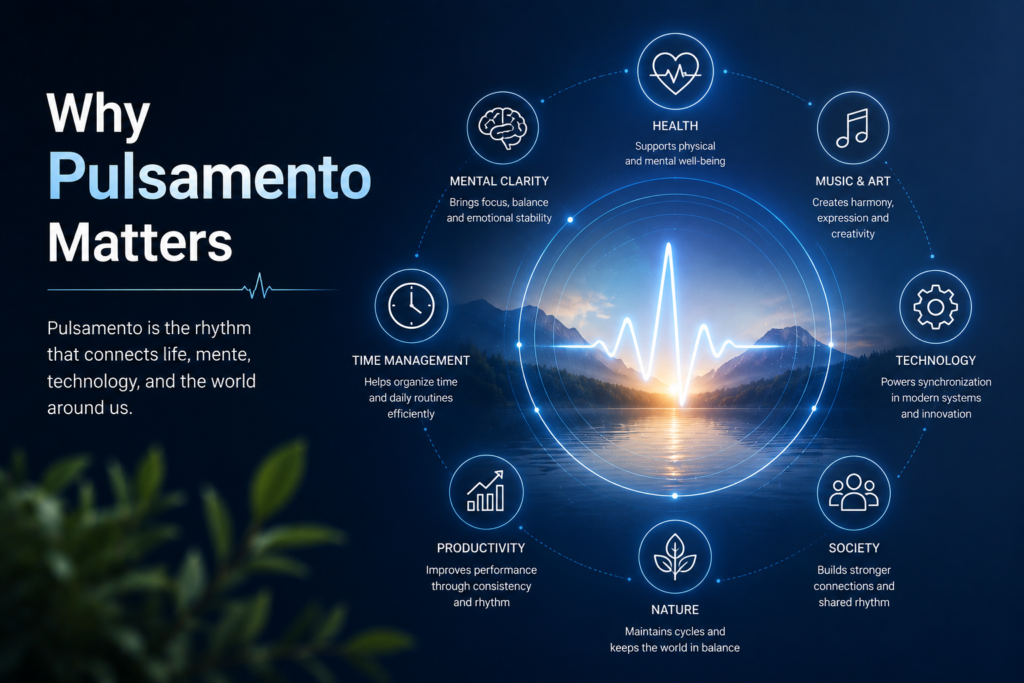
Once this clicks, it gets a lot easier to see how rhythm holds both the simple stuff and the genuinely complicated systems together.
Rhythm is essential to music because it gives a composition structure and keeps performers synchronized. Inside the human body, rhythmic processes support essential functions such as breathing, circulation, and sleep. Computer networks also depend on precise timing to keep devices communicating and systems working together efficiently.
It Creates Stability
Patterns you can predict are patterns you can trust. In nature or in a machine, Pulsamento cuts down on chaos and keeps things from spiraling.
It Improves Coordination
Ask any musician — staying in time with the rest of the band isn’t optional. Athletes lean on the same principle; timing and rhythm sharpen how well the body moves.
It Supports Health
Sleep, breathing, hormones, digestion, heart rate — none of it works well without a rhythm behind it.
It Increases Productivity
People tend to get more done when the day follows some kind of pattern instead of chaos. That’s Pulsamento showing up in a very practical way, and it usually means better focus and less stress.
It Connects Different Fields
Here’s the interesting part — music, medicine, technology, psychology, and business don’t look alike on the surface, yet they all lean on rhythm to function. That overlap is basically what Pulsamento is pointing at.
How Pulsamento Shapes Everyday Life
Most people run into Pulsamento constantly and never notice it.
Your alarm goes off at roughly the same time every day. Meals happen on a loop. Work follows some kind of schedule, loose or strict. Even a normal conversation has rhythm to it — people take turns talking without anyone announcing whose turn it is.
A few places it shows up without anyone labeling it:
- Walking pace
- Running rhythm
- Typing speed
- Reading patterns
- Exercise routines
- Meditation breathing
- School schedules
- Office workflows
- Traffic signals
- Public transportation
None of this is an accident. People who build strong routines usually aren’t doing it for fun — consistency removes a lot of small decisions from the day, and that alone tends to improve how much actually gets done.
Natural Examples of Pulsamento
Nature doesn’t need convincing. It’s been running on Pulsamento long before anyone bothered naming it.
Ocean waves roll in, pull back, and do it again — one of the most recognizable rhythms there is.
Sunrise and sunset happen because the Earth keeps turning, a cycle so dependable that civilizations have planned their entire lives around it.
The seasons shift from spring to summer to autumn to winter and back again, shaping everything from farming schedules to animal behavior.
Rainfall follows its own loop too — evaporation, clouds, rain, repeat — tied closely to climate patterns.
Migration sends entire species moving at almost the same time each year, driven by timing built into their biology.
Put it all together and it’s obvious Pulsamento isn’t confined to one corner of the natural world. It’s closer to a rule the whole planet follows.
Pulsamento in the Human Body
If you want the clearest example of Pulsamento, you don’t have to look any further than your own chest.
Every healthy heartbeat follows a rhythm that pushes oxygen and nutrients through the body. Breathing runs on the same kind of loop — inhale, exhale, repeat, without a single conscious decision required.
A few more places the body keeps its own beat:
- Sleep-wake cycles
- Hormone release
- Brain wave activity
- Digestion
- Body temperature regulation
- Cellular repair
- Blood circulation
All of these stay linked because their timing lines up. Mess with that timing — bad sleep, irregular meals, constant stress — and fatigue or brain fog usually follows pretty quickly. That’s why sticking to healthy habits does more than just feel good; it keeps the body’s internal rhythm from falling apart.
Pulsamento in Music
Music might be the most obvious home for Pulsamento. Take away rhythm, tempo, or timing and a song stops being a song — it turns into noise, and performers lose their grip on each other.
Musicians sometimes call it the invisible heartbeat of a piece. Listeners usually pay attention to the vocals or the lead instrument, but underneath all of that, the pulse is what’s actually holding the whole thing together.
- A drummer carries the Pulsamento for the entire band
- Guitarists and pianists lock their timing to that rhythm
- Singers stay on beat because of it
- Conductors use their hands to guide a whole orchestra’s Pulsamento
Doesn’t matter if it’s classical, jazz, rock, EDM, or pop — every genre needs it. The tighter the rhythmic foundation, the more a performance actually lands emotionally. Even production software these days measures timing down to the millisecond, letting producers polish a track’s Pulsamento before it ever gets released.
Pulsamento in Technology
People don’t usually connect Pulsamento to technology, but it’s arguably just as important there as it is in music.
Computers process information through repeating electrical signals, over and over, thousands of times a second. Processors, servers, and networking hardware all depend on that timing staying in sync.
- Processors executing instructions
- Data moving across the internet
- Cloud computing systems
- AI models running calculations
- Robotics
- Wireless communication
- Smart home devices
Get that timing wrong and devices simply stop talking to each other properly. Your phone, for instance, is quietly syncing data between apps in the background right now — a hidden, technological version of Pulsamento running constantly. As AI keeps growing, this kind of synchronized timing is only going to matter more.
Pulsamento in Psychology
Human behavior has its own rhythm too, and psychologists have been studying it for decades.
Repeated habits shape emotions, motivation, focus, and overall mental health — which is really just Pulsamento showing up in behavior instead of biology.
People who keep a consistent schedule tend to report:
- Better concentration
- More emotional stability
- Lower anxiety
- Higher productivity
- Better sleep
- Sharper decision-making
Break the routine and mental fatigue tends to creep in faster. Students who study at the same time daily usually retain more than the ones who cram randomly. Athletes see the same effect — repeating a training schedule builds muscle memory in a way that random effort never quite matches. Point being, Pulsamento isn’t just physical. It runs through the mind just as much.
Pulsamento in Business and Productivity

Businesses run on cycles whether anyone calls it that or not.
Daily meetings, production schedules, financial reports, customer support — all of it depends on processes repeating in a predictable way. Companies that get this right usually build a kind of internal Pulsamento across every department.
- Weekly team meetings
- Monthly financial reports
- Quarterly business reviews
- Annual strategic planning
- Daily manufacturing cycles
- Customer follow-up schedules
Businesses that keep a steady rhythm generally outperform the ones limping along without structure. This isn’t limited to big companies either — a freelancer who writes every morning, exercises on schedule, and reviews goals weekly is running the exact same principle on a smaller scale. Consistency usually beats a random burst of effort, even a big one.
Pulsamento and Human Creativity
There’s a common belief that creativity needs total freedom, no rules, no structure. Talk to actual working artists and you’ll usually hear the opposite.
Plenty of successful writers, painters, musicians, and designers run on routines, and those routines basically become their personal Pulsamento.
- Writers often sit down at the same hour every single day
- Painters block off specific studio hours
- Musicians run through scales before writing anything new
- Designers follow workflows they can repeat without reinventing the process each time
Instead of boxing creativity in, Pulsamento gives it something to stand on. Ask most creative professionals and they’ll tell you inspiration shows up a lot more reliably once the habit is already built.
Real-Life Applications of Pulsamento
This isn’t an abstract idea — it shows up in practical, everyday situations constantly.
Education. Lessons follow daily and weekly schedules, and students generally retain more when study sessions stay consistent.
Sports. Running, swimming, cycling, strength training — all of it improves through repeated, rhythmic practice.
Healthcare. Doctors track heart rate, breathing, and sleep patterns because these biological rhythms are measurable, and measurable rhythms tell a story about health.
Transportation. Traffic lights run on timed cycles, trains follow synchronized schedules, and airports juggle thousands of flights using carefully managed timing.
Manufacturing. Factories depend on repetitive cycles, with machines syncing their operations to squeeze out maximum efficiency.
Benefits of Understanding Pulsamento
Knowing what Pulsamento is isn’t just trivia — it comes with real, practical upside.
Better time management. Structured routines waste less time and get more done.
Better health. Regular eating, exercise, and sleep all depend on the body’s rhythm staying consistent.
Higher productivity. Predictable processes tend to outperform chaotic ones, for individuals and organizations alike.
Stronger relationships. Shared routines — meals, celebrations, regular check-ins — tend to bring families closer.
More emotional balance. Consistent habits cut down on uncertainty, which is valuable at pretty much any age.
Pulsamento Across Different Fields
| Field | Role of Pulsamento |
| Music | Maintains rhythm and tempo |
| Biology | Controls heartbeat, breathing, and body cycles |
| Technology | Synchronizes digital systems |
| Psychology | Supports habits and mental stability |
| Education | Encourages consistent learning |
| Business | Improves workflow and planning |
| Sports | Enhances coordination and performance |
| Nature | Governs recurring environmental cycles |
Expert Perspective
Ask an expert from any field and rhythm tends to come up as one of the most basic building blocks of an organized system.
Musicians talk about timing. Biologists study repeating physiological cycles. Engineers depend on synchronized operations. Psychologists dig into behavioral patterns. Different words, different fields — but they’re all circling the same idea: organized, recurring movement. That’s Pulsamento, no matter what label a particular field puts on it.
Pulsamento vs Pulse
These two words get mixed up constantly, but they’re not quite interchangeable.
| Pulsamento | Pulse |
| A broader idea — rhythm, recurring movement, synchronized patterns | A single beat or measurable rhythm, often in medicine or music |
| Shows up in music, tech, psychology, biology, business, nature | Usually just means heartbeat, musical beat, or signal frequency |
| Describes whole systems, routines, repeating cycles | Refers to one specific measurement |
| Represents continuous flow and synchronization | Represents one beat, or a short sequence of them |
Basically, every pulse is a small piece of a larger Pulsamento. Pulsamento is the whole system; pulse is just one beat inside it.
Pulsamento vs Rhythm
People confuse these two as well. Here’s the short version:
- Pulse is the steady beat itself
- Rhythm is the pattern built out of that beat
- Pulsamento is the whole continuous flow keeping everything in sync
Think about clapping. The steady gap between claps is the pulse. Different clapping patterns create rhythm. And the entire organized motion over time — that’s Pulsamento. Small distinction, but it explains why the word keeps popping up outside of music too.
Common Myths About Pulsamento
Myth 1: It’s only a music thing. Not really. Musicians use it constantly, sure, but it applies just as much to biology, engineering, psychology, business, and natural systems.
Myth 2: It just means heartbeat. Heartbeat is one example out of many. Any recurring, organized rhythm counts.
Myth 3: It’s a complicated concept. Not particularly. It’s repeating patterns that create stability and continuity — that’s really the whole idea.
Myth 4: It has no real-world use. From daily scheduling to designing computer systems, understanding rhythm has a direct, practical payoff.
The Future of Pulsamento
As technology keeps moving forward, Pulsamento isn’t going away — if anything, it’s becoming more central.
Fields leaning on synchronized systems keep multiplying:
- Artificial Intelligence
- Machine Learning
- Smart Cities
- Internet of Things (IoT)
- Robotics
- Autonomous Vehicles
- Wearable Health Devices
- Cloud Computing
Doctors now pull rhythmic biological data straight from smartwatches and medical sensors. Businesses run automated workflows on predefined schedules that repeat without anyone lifting a finger. Going forward, Pulsamento will likely stay at the center of how humans, machines, and digital systems stay in sync with each other.
Frequently Asked Questions (FAQs)
1. What does Pulsamento mean? A recurring rhythm, pulse, or synchronized pattern found across music, biology, technology, psychology, and more.
2. Is Pulsamento only used in music? No — it shows up in science, medicine, engineering, business, and everyday routines just as much.
3. What’s the difference between Pulsamento and Pulse? Pulse is one beat. Pulsamento is the entire system of continuous, coordinated rhythm.
4. Why does Pulsamento matter? It keeps systems organized, synchronized, stable, and efficient — natural, technological, or human.
5. Can Pulsamento improve productivity? Yes. Predictable routines create a rhythm that usually leads to better time management and output.
6. How does Pulsamento relate to health? Heartbeat, breathing, sleep cycles, and hormone regulation are all biological rhythms — all forms of Pulsamento.
7. How is Pulsamento used in technology? Computers, networks, AI, and automated systems all depend on synchronized timing to function properly.
8. Is Pulsamento connected to psychology? Yes — daily habits and consistent routines reflect behavioral patterns tied to emotional balance and mental health.
9. Can businesses benefit from Pulsamento? Definitely. Organized schedules and repeatable processes tend to make businesses run more efficiently over time.
10. What’s the simplest way to understand Pulsamento? It’s the rhythm keeping a system working together — a heartbeat, a musical beat, or a daily routine, all built on repetition and sync.
Final Thoughts
Pulsamento isn’t just a musical term someone dressed up to sound fancy. It’s a genuinely universal principle — rhythm, repetition, coordinated movement — running through nature, human behavior, science, technology, and business all at once.
From the beat of a song to the beat of your own heart, from automated systems to the small daily habits that quietly boost productivity, Pulsamento keeps pointing to the same thing: consistency and synchronization matter. Spot these recurring patterns and it gets a lot easier to build something — a routine, a business, a life — that actually holds together.
As technology and research keep pushing forward, Pulsamento isn’t losing relevance any time soon. If anything, understanding it is a decent shortcut to understanding how the world actually runs — through cycles that repeat, and rhythms that rarely stop.