
I’ve read a stack of resumes over the years, lost count a while back. Most share the same problem. They read like a job description someone lifted off LinkedIn, not a pitch aimed at an actual person on the other end.
If you’re a software engineer trying to get noticed right now, that matters, because hiring in 2026 isn’t gentle. Not exaggerating this part. Every year brings more graduates, more self-taught devs who pieced the whole stack together from scattered tutorials and pure stubbornness, more senior people who got let go last quarter and are back circling job boards. All chasing roughly the same short list of openings.
Nobody spells this part out though. Plenty of solid engineers just never hear back. Usually it isn’t because they can’t build things. It’s that a piece of software already rejected them before a person ever opened the file.
That’s the setup now, whether anyone likes it or not. Companies run applications through an ATS first. It scans for keywords, job titles, tools you’ve listed, years logged in the field. Miss that language and your resume can sit buried for months while someone with weaker skills but a sharper-formatted file gets the callback instead.
So skip the fancy template hunt. That’s not the actual fix here.
What works is proof. You solved real problems, shipped reliable code, and delivered measurable results that made a meaningful impact. Strip away the noise and that’s basically the whole game.
This guide covers writing something that clears an ATS filter and still reads well once a person opens it. Which format suits where you’re standing right now. Talking about side projects without blending into the fortieth resume in that day’s stack. And a bunch of small, dumb mistakes that quietly sink good applications, mistakes nobody ever explains because rejections rarely come with a reason attached.
Fresh grad, junior dev, or ten years into a senior title, the starting point barely matters. There’s something worth taking from this either way.
Table of Contents
- What Is a Software Engineer Resume?
- Why Your Resume Matters More Than Ever
- How Recruiters Actually Read Your Resume
- How ATS Filters Software Engineer Resumes
- The Essential Sections Every Resume Needs
- Professional Resume Header
- Writing a Powerful Resume Summary
- Technical Skills That Employers Want
- Work Experience That Gets Interviews
What Is a Software Engineer Resume?
Set the word resume aside for a second. Pitch is closer to what it actually is. Skills, projects, education, whatever track record exists, arranged to answer one question a recruiter’s quietly running through their head while skimming: can this person fix what my team’s stuck on right now?
Most people write it like a diary entry. Did this. Then did this. Then that happened. Doesn’t work well. What works is showing what shifted because you were in the room.
Two flat lines: developed web applications, worked with Java, fixed bugs.
Same person, told differently: built web applications that ended up supporting more than 800,000 monthly users, trimmed API response time by 42% through backend changes, automated a deployment process so a three-hour release turned into twenty minutes.
Might be the exact same guy, same job, even the same year. Reads like a completely different resume though, because now a recruiter can see precisely what got better while you were on the job. That’s the whole trick, more or less, if it deserves that word at all.
Why Your Resume Matters More Than Ever
Tech keeps expanding, sure. So does the pile landing on a recruiter’s desk every morning. A single opening can pull in hundreds of applications, sometimes well into the thousands depending on the company and how visible the posting is. Nobody’s reading all of that with care, that’s simply not possible given the volume. People glance. A few seconds pass and they’ve largely already decided if you’re worth another look.
What does a strong resume buy you then? It clears the ATS to start. Catches attention quickly, before a thumb swipes to the next tab. Shows you actually know the material rather than just stating it. Points to results instead of a vague list of duties you were handed.
Over time it turns into more interviews, which is really the only reason to bother writing one carefully in the first place.
A weak resume skips all that. It gets filtered out before your real ability even enters the picture, which might be the most frustrating way there is to lose a shot at something you were genuinely capable of doing.
How Recruiters Actually Read a Software Engineer Resume
Most job seekers picture a recruiter reading every line from the top down, like a short story with a proper arc. Rarely plays out that way in practice.
What actually happens is a scan, and it follows a fairly predictable order.
Contact Information — Is it there at all. Does it look put-together. Can someone reach you without digging.
Professional Summary — Do you sound like you belong in this role immediately, or does the recruiter have to connect the dots themselves.
Technical Skills — Do you genuinely have what the posting is asking for, stated plainly.
Work Experience — Results, or a list of tasks somebody handed you.
Projects — Can you actually build things, or does it stay theoretical on the page.
Education and Certifications — Do you clear whatever baseline the role sets, nothing beyond that expected.
Line up with the first couple sections and they keep going. Miss that alignment and you’ve lost them for good, no amount of polish further down rescues that first impression. Clarity wins over decoration nearly every time.
How Applicant Tracking Systems (ATS) Filter Software Engineer Resumes
Before a human reads your resume, odds are decent that software already ran through it. ATS platforms look for job titles, programming languages, frameworks, cloud platforms, databases, certifications, keywords, years logged in the role. A checklist version of the posting, essentially.
Take a company hiring a Backend Software Engineer where the listing mentions Java, Spring Boot, Docker, Kubernetes, PostgreSQL, AWS, REST APIs. If those tools genuinely fit your background, work them into your experience section the way they’d naturally show up in conversation. Don’t force them in purely to trip a keyword match somewhere. ATS software has gotten sharper about catching that, and recruiters pick up on it too, usually fast.
The goal was never fooling an algorithm anyway. It’s describing what you can actually do, using language an employer’s already searching for.
The Essential Sections Every Software Engineer Resume Should Include
Professional Contact Information
Keep this part simple, nothing complicated needed. Your name, an email that sounds like an adult picked it (not something left over from school), a phone number, roughly where you’re based, links to LinkedIn and GitHub. A portfolio too, if there’s one worth pointing to. Leave out anything nobody’s asking for, age, marital status, religion, ID numbers, that category of detail, unless an application specifically requests it.
Professional Resume Summary
Usually the very first thing a recruiter reads. People underrate how much weight it carries in those opening seconds.
“Hardworking software engineer looking for new opportunities.” That line says nothing at all. Could describe anyone breathing.
Try something closer to this instead. Five years in, mostly Java and Python on the backend with React on the front end, AWS for hosting most of it. Shaved application load time down by close to 40% on one project last year, built out the deployment automation so releases stopped being a whole event. Still enjoys the messy parts of engineering, the debugging at 11pm, the “why is this query suddenly slow” kind of problems.
One paragraph, and now a recruiter already knows your stack, roughly your seniority, and what you’ve actually managed to pull off. Doesn’t need to sound like a press release either.
Technical Skills
Please don’t dump every tool you’ve touched into one giant wall of text. Group it somehow.
Languages on their own line, Python, Java, JavaScript, TypeScript, Go, C++, PHP, whatever applies. Frameworks separately, React, Angular, Vue, Node, Django, Spring Boot, Laravel. Databases on their own too, MySQL, PostgreSQL, MongoDB, Redis. Cloud and DevOps usually together, AWS, Azure, GCP, Docker, Kubernetes, Jenkins, Terraform. Tools near the bottom, Git, GitHub, GitLab, Postman, VS Code.
Sounds minor written out like that, but it changes how fast someone can skim it, and it helps an ATS match categories properly against whatever the posting listed.
Work Experience
Nobody gets hired purely for “using” a technology. You get hired for what that technology let you actually accomplish while you were the one holding it.
Skip anything like “worked on backend development” or “built APIs” or “fixed software bugs.” Those lines carry no weight for someone skimming fast.
Try this instead: designed scalable REST APIs handling over 1.5 million monthly requests, cut application response time by 38% through database indexing and query cleanup, automated CI/CD pipelines using GitHub Actions and dropped deployment time by 70%, worked across teams to launch four major releases ahead of schedule.
Numbers carry most of the weight here. They turn a vague claim into something a stranger can trust without meeting you first.
Best Software Engineer Resume Formats
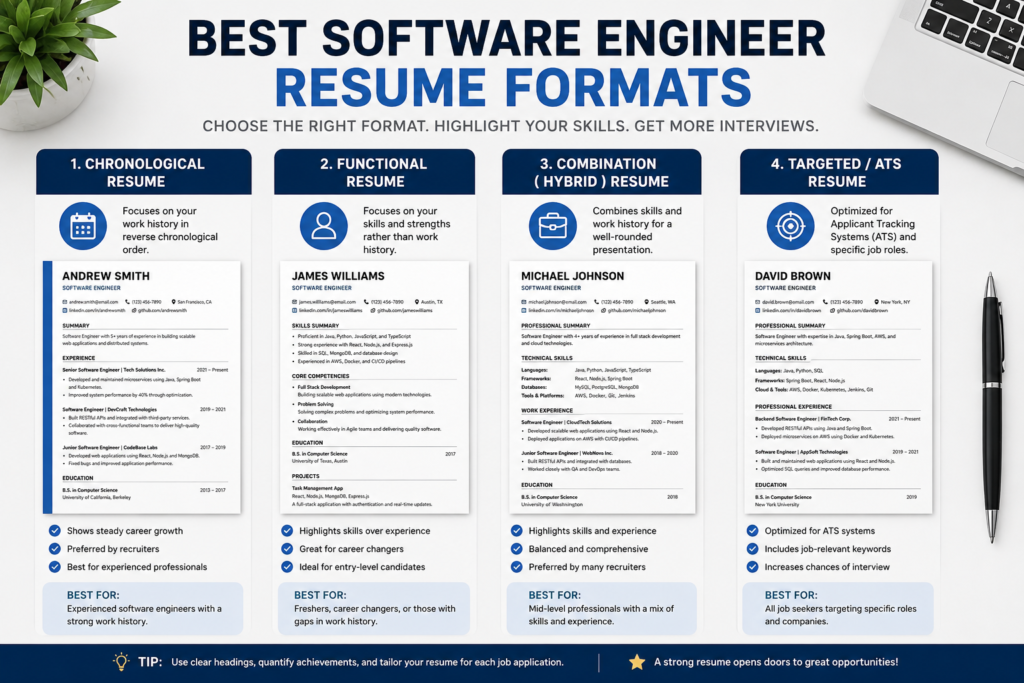
Content matters most, sure, but format matters more than people tend to admit out loud. A genuinely strong engineer can get skipped over purely because their resume was a pain to skim in the ten seconds a recruiter actually gave it.
Reverse Chronological Resume (Recommended)
The default, and there’s a reason for that. Most recent job first, working backward from there. It’s what recruiters expect going in, and it’s basically the structure most ATS software gets built around too. Experienced engineer, full-stack, backend, frontend, DevOps, cloud, whatever the lane, this is probably where to start. Easy for an ATS to parse, easy for a human to scan, and it shows growth without needing extra explanation.
Real work experience already sitting there? Just use this format. No need to overthink it.
Functional Resume
Flips the order around. Skills and projects lead, work history sits further down the page. Makes sense for career switchers, fresh grads, self-taught developers, freelancers, or anyone with gaps they’d rather not put front and center.
Worth flagging though. Plenty of recruiters still want a clean employment timeline, so this format can quietly work against a candidate who already has decent experience worth leading with.
Hybrid Resume
A blend of both. Skills near the top, experience right underneath. Fits engineers roughly three to ten years in, people working in AI and ML, cloud architects, senior developers who’ve touched a bit of everything and want space to show both range and results side by side.
How to Build an ATS-Friendly Software Engineer Resume
ATS software isn’t evaluating creativity, not even slightly. It’s mechanically checking relevance against a job description and moving along. Skip building around that and the resume might never reach a human at all, regardless of actual skill level.
Use Standard Resume Headings
Stick to headings the ATS recognizes. Professional Summary, Technical Skills, Work Experience, Projects, Education, Certifications. Skip clever titles like “My Journey” or “Technical Adventures.” Might feel fun while writing it. The parser has no opinion on cleverness, and most recruiters won’t either.
Match Keywords Naturally
Posting wants Python, FastAPI, Docker, Kubernetes, PostgreSQL, AWS? Work those in wherever they genuinely apply to real work done. Never claim a tool never actually used. Falls apart fast the moment an interviewer asks a single follow-up question about it.
Keep Formatting Clean
One column. Standard fonts. Black text. Bullet points. Consistent spacing. That covers most of it. Tables, icons, charts, images, multi-column layouts look sharp in a template preview and then quietly wreck ATS parsing without anyone finding out until much later.
Save Your Resume Correctly
Unless told otherwise, save as PDF. Keeps formatting intact across devices, plays nicely with most ATS systems currently in use.
Recruiters don’t really care what a job title implies you were supposed to do. They care what actually happened while you occupied that seat.
How to Write a Powerful Work Experience Section
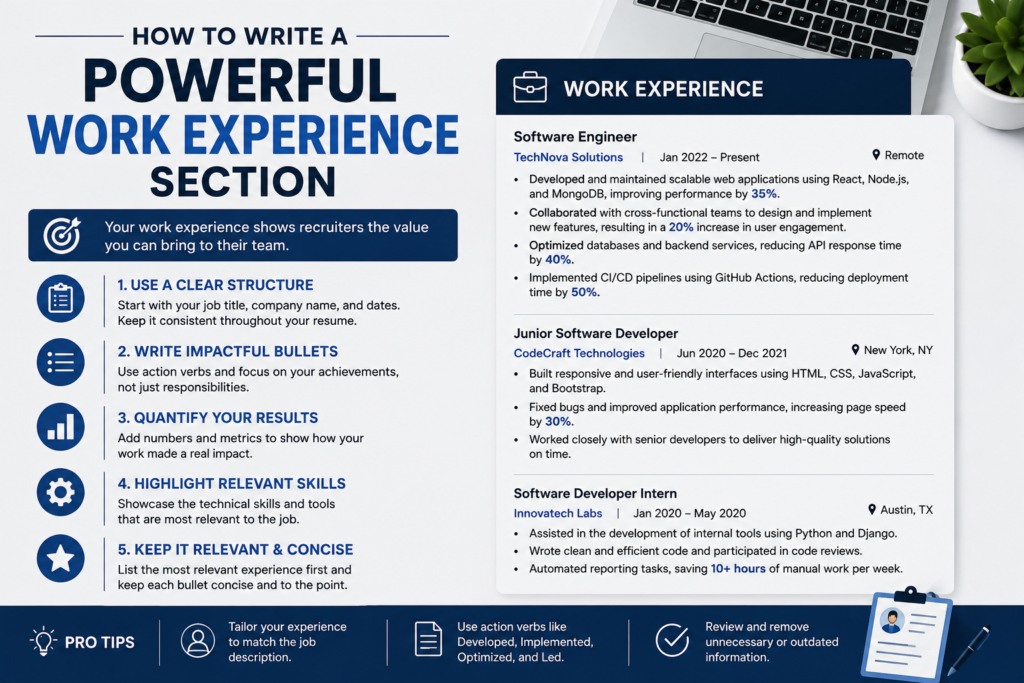
Weak version, Software Engineer at ABC Technologies: developed web applications, fixed bugs, worked with Java, assisted senior developers. Says nothing to anyone.
Strong version, identical job title: designed scalable REST APIs serving more than 2 million monthly requests, cut response time by 45% through SQL query optimization, automated deployment using Docker and GitHub Actions and dropped release time by 70%, improved reliability through automated testing and reduced production bugs by 35%, worked with product and design on five successful launches.
Every one of those lines quietly answers the same underlying question. So what.
Follow the STAR Method
Stuck turning a vague memory into a real bullet? Try the STAR structure. Situation, task, action, result.
Say performance was dragging as traffic climbed, that’s the situation. Getting asked to fix it, that’s the task. Adding Redis caching and cleaning up the PostgreSQL queries, that’s the action taken. Response time dropping 52%, satisfaction scores climbing right alongside it, that’s the result.
Simple shape, but it makes a story land with someone reading fast on a random Tuesday.
How to Showcase Projects That Impress Recruiters
Student, or a junior dev without much of a professional record yet? Projects might carry more weight here than anything else on the page. Every project listed should answer four things. Every project on your software engineer resume should clearly explain what you built, which technologies you used, the problem you solved, and the measurable results your solution delivered.
AI Expense Tracker, built with Python, React, FastAPI, PostgreSQL, Docker. Basically an app that watched spending and sorted it into categories on its own using a small ML model instead of manual tagging. Categorization accuracy landed around 41% better than the rule-based version it replaced, processing time dropped by 38%, proper JWT auth got added in, and the dashboard updates in real time instead of on a refresh cycle.
E-Commerce Platform, built with Laravel, MySQL, Bootstrap, the Stripe API. A full shopping site, payments, inventory, login, all of it. Page speed jumped 47% after backend cleanup, fewer database queries once indexing got sorted properly, checkout completion climbed about 28%, which mattered more than the rest of the numbers honestly, since that one ties directly to revenue.
Projects along these lines say more than a hundred classroom assignments ever could.
Education Section
Keep it brief here, doesn’t need much. Degree, school, graduation year. Coursework or GPA only if there’s a real reason to mention it.
Bachelor of Science in Software Engineering. University of Engineering and Technology. Graduated 2025.
Relevant coursework worth listing: Data Structures, Algorithms, Software Engineering, Database Systems, Operating Systems, Artificial Intelligence.
Certifications That Add Real Value
Certifications signal an employer that learning didn’t stop once the job started, which counts for more than people tend to assume.
Leaning cloud? Look at AWS Certified Solutions Architect or the Google Associate Cloud Engineer track, maybe Azure Developer Associate depending which platform feels closer to home. Working in DevOps? Docker Certified Associate and the CKA carry real weight in that space. Closer to classic programming work? Oracle’s Java certification still means something in plenty of places, same goes for Microsoft’s developer track. And for anyone leaning toward the process side, Certified Scrum Master or the PMI Agile credential help there.
Only list what’s genuinely been earned, or what’s actively being worked toward this month. Not whatever sounds impressive sitting on a page doing nothing.
Technical Skills Every Software Engineer Should Consider
Group these too, same idea as before, don’t just dump them into one line.
Languages: Python, Java, JavaScript, TypeScript, Go, C++, PHP. Frameworks: React, Angular, Vue.js, Node.js, Django, Spring Boot, Laravel. Databases: MySQL, PostgreSQL, MongoDB, Redis. Cloud: AWS, Azure, Google Cloud Platform. DevOps: Docker, Kubernetes, Jenkins, Terraform. Tools: Git, GitHub, GitLab, Postman, VS Code.
Organized this way, it’s quicker for a human to skim and easier for an ATS to line up against whatever a posting listed.
Soft Skills Recruiters Actually Notice
Technical skill gets a foot through the door. How someone actually works with people is what carries the rest of the way in. Problem-solving, communication, leadership, critical thinking, collaboration, adaptability, time management, decision-making, analytical thinking, all of it counts for something real.
Don’t just drop the words on a page and call it finished though. Back them with something concrete wherever possible. “Led a team of four through a rushed launch” says considerably more than the word leadership sitting there by itself ever could.
Pro Tip
Sending the same resume to every company is one of the most common mistakes out there. It’s an easy one to fix too, which makes it a little frustrating watching people still do it. Just read the actual posting before applying. Nudge the skills, the projects, the wording to match what’s genuinely being asked for. Doesn’t take long, maybe fifteen minutes if being thorough about it. Shows up in the callback rate more than most expect going in.
Entry-Level Software Engineer Resume Example
No professional experience yet? Recruiters already know that walking in, so there’s no need to stress over it heavily. Lean on academic projects, internships, certifications, hackathons, GitHub repos, whatever skills have actually been built up so far.
Example: recent CS grad, spent the last year building full-stack projects in Java, Python, React, MySQL, mostly through internships and side work since a full-time role hadn’t happened yet. Comfortable with OOP concepts, REST APIs, Git, the basics of cloud deployment. Still sorting out the finer points but picks things up quickly and actually finishes what gets started, which matters more at this stage than knowing every framework by name.
Senior Software Engineer Resume Example
At this stage it’s less about proving the ability to code, more about proving the ability to lead. Architecture calls. Mentoring. Actual business impact that shows up somewhere in a number.
Example: over a decade in, mostly Java and Spring Boot with a heavy Kubernetes and AWS footprint the last few years. Ran engineering teams across a couple of major projects, pushed performance up around 45% on the core platform, trimmed infrastructure spend by roughly 30% after a migration that took most of a year to get right. Systems built along the way are still running at scale for millions of users, which is really the only metric that matters this far into a career.
Resume Summary vs Resume Objective
People mix these two up constantly. They’re not really the same thing at all.
A summary works best once real experience already exists, years in the field, technical strengths, achievements genuinely worth being proud of. Example: six years building cloud applications with Java, React, Docker, AWS. Got deployment speed up by 65% at one point, spent a stretch optimizing backend services, shipped secure enterprise apps for a few international clients along the way.
An objective fits better for fresh grads, career changers, internship applicants, basically anyone whose value isn’t a track record yet, it’s mostly potential. Example: CS graduate looking for an entry-level engineering role, wants to put the programming knowledge to actual use, contribute to real projects, and keep sharpening both the technical and problem-solving side of things on the job.
Recruiter Tips Most Candidates Ignore
A handful of small habits that matter more than most people credit them for.
Customize every resume, even the tenth one going out that week, even at midnight before a deadline nearly forgotten about. Chase results over duties, basically always, since “reduced response time by 40% on the core API” beats “developed APIs” every single time without exception. Still early in the career? Lean hard on the best projects available, the link, the stack used, the actual problem, what happened once it shipped. And keep learning somewhere visible, certifications, some open-source contributions, side projects, maybe an occasional write-up for anyone who enjoys that. Recruiters can usually tell the difference between someone still pushing forward and someone who’s been coasting for a while.
Common Software Engineer Resume Mistakes
Even genuinely skilled developers trip over these more often than expected.
There’s the classic one, reusing the exact same resume for every application without touching a word. Then there’s writing responsibilities instead of results, because nobody cares what someone was technically assigned, they care what actually happened. Keyword stuffing shows up a lot too, and it reads as desperate the moment it gets noticed. Soft skills get skipped entirely as well, as if software somehow gets built by one person locked in a room alone, which obviously isn’t how any of this works. And then formatting, multiple columns, too many fonts, heavy graphics crammed onto a page meant to stay simple, quietly breaking ATS parsing before anyone even gets to judge the actual work underneath it.
Software Engineer Resume Checklist
Before hitting send on this thing, run through it once more. Proper summary sitting up top. Layout something an ATS can actually parse without choking on it. Technical skills roughly matching what the job’s asking for. Achievements backed by real numbers, not just adjectives strung together. GitHub link there. LinkedIn there. Portfolio too, if it exists. Certifications listed, but only the real ones earned. Action verbs doing the work instead of passive filler sitting around. Keywords pulled from the actual posting, not guessed at from memory.
And reread the whole thing once for typos and awkward grammar before it goes out anywhere. Takes two minutes, saves from looking careless later.
Frequently Asked Questions
How long should a software engineer resume be?
One page covers most people. If there’s a while in the field and genuinely enough worth saying, two pages works too, provided nothing’s just padding space for the sake of it.
What is the best format for a software engineer resume?
Reverse chronological, most of the time. Recruiters read it fast without friction, and ATS software is basically built around that exact structure.
What technical skills should I include?
Whatever’s actually known how to use, not whatever sounds impressive. Python, React, Docker genuinely part of the world? List those. Skip adding Kubernetes just because it looked good on someone else’s resume once.
Should I include GitHub on my resume?
Pretty much always, yes. A GitHub with real projects sitting in it backs up everything claimed earlier on the page.
Is a portfolio necessary?
Not required, but it doesn’t hurt at all. Gives a recruiter something to click into and actually see instead of just taking someone’s word for it.
How can I improve my chances of passing ATS?
Headings the system recognizes. Formatting kept boring on purpose. Numbers wherever possible. Tailoring per job instead of blasting one file everywhere. None of it’s complicated, just takes a bit of extra effort each time it’s done.
Can fresh graduates write an effective software engineer resume?
Easily, yes. A solid internship, a couple of real projects, maybe a hackathon, some visible GitHub activity, that’s plenty to work with even without a job title attached yet.
Which certifications are most valuable?
Right now it’s things like AWS Certified Solutions Architect, Azure Developer Associate, Google’s Associate Cloud Engineer, the CKA for anyone in Kubernetes, and Certified Scrum Master for those leaning more toward process and leadership work.
Final Thoughts
A good software engineer resume isn’t really a list of tools touched or jobs held at some point along the way. It’s evidence, more than anything, that real problems got solved, things actually shipped and held up, and some kind of measurable mark got left wherever the work happened.
Internship, first job, senior role, whichever one applies right now barely matters. What needs to come through is real skill, real projects, real results, and proof that learning hasn’t stopped. That’s what employers are actually looking for underneath the posting language, whether they spell it out directly or not.
The strongest resume is always the one built specifically for whatever job sits in front of it. Read the posting closely first. Match what exists to what’s actually needed. Back it with numbers wherever honestly possible. A solid LinkedIn, an active GitHub, a couple of real projects worth pointing to, it adds up more than most people expect walking in.
One more thing worth saying here. A resume is never really finished, not truly. Update it with growth. New certification. Stronger project. A bit more experience logged over time. Keep it current, and the odds of landing that next interview keep climbing right alongside it.